The Knowledge Evacuation: Mainframe Expertise Is Leaving American Enterprises Faster Than Anyone Is Budgeting For
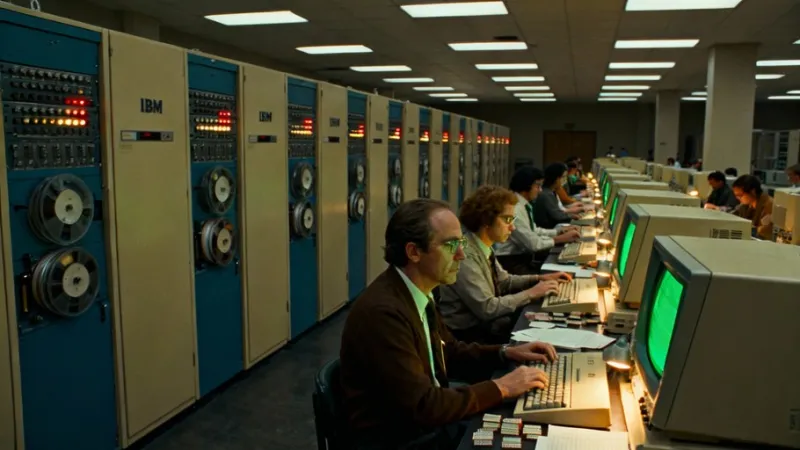
Photo: elderly engineer working mainframe computer terminal retro office, via images.stockcake.com
Here is a scenario playing out right now across the American corporate landscape: a bank in the Midwest, an insurer in Hartford, a retailer running its replenishment engine on a z-series mainframe, each staffed by a legacy systems team with a median age north of 55. Leadership has seen the demographic charts. Everyone agrees this is a problem for the 2030s.
That timeline is a comfortable fiction. The crisis is a 2026 problem, and the arithmetic is unforgiving.
Why the Math Breaks the Planning Horizon
Consider the actual mechanics. The engineers who wrote and maintained the core transaction systems of the 1970s through 1990s are now in their late fifties and sixties. They are not retiring all at once in 2035—they are retiring continuously, a few per year, starting now. Each departure removes knowledge that is largely undocumented, because these systems were built in an era when the documentation was the people who wrote the code.
Worse, the knowledge does not leave cleanly. It degrades in stages: first the ability to make changes confidently, then the ability to diagnose failures quickly, then finally the ability to understand the system at all. An enterprise can have a fully staffed mainframe team on paper and still be functionally bankrupt in legacy expertise, because the two or three people who understand the nightly batch settlement cycle retired two years ago.
The hiring side of the ledger is no better. Universities have not taught COBOL as a core competency in decades, and the labor market for mainframe skills is a zero-sum competition among the same banks, insurers, and government agencies—all of whom are bidding for a shrinking pool. We have written previously about how enterprise hiring strategies prepare for the last war; this is that pattern at its most consequential. You cannot backfill thirty years of batch-processing intuition with a bootcamp graduate and a six-month runway.
The Documentation Fallacy
The default corporate response is a 'documentation project': capture what the experts know, write it down, and hand it to the next generation. These projects fail for a structural reason. Documentation captures what the system does; it cannot capture why those choices were made, which regulations shaped which behaviors, or which of the 400 nightly jobs can safely fail and which will halt the entire settlement chain.
Worse, documentation projects are perennially the first line item deferred. They produce no revenue, ship no features, and their absence is invisible—until the night the check-processing engine throws an abend no one alive can interpret. Then the cost arrives all at once, in the form of an emergency contractor engagement billed at crisis rates.
Fund It Like the Asset It Is
The argument of this piece is simple: legacy knowledge transfer should be treated as a funded, deadline-driven initiative with the same governance rigor as any regulatory compliance program—because functionally, that is what it is. The operational continuity of systems that clear payments, process claims, and run supply chains depends on it.
What does a properly funded program look like?
- Paired reverse-mentorship, not documentation. Put younger engineers inside the batch cycle alongside veterans, with a mandate to change code, break things in test, and rebuild. Knowledge sticks through practice, not prose.
- Retirement as a contract, not a cliff. Offer departing experts structured retainers—six to twenty-four months of part-time advisory work. It is dramatically cheaper than emergency consulting after the fact.
- Failure-mode archaeology. Prioritize capturing the exception paths: the jobs that fail silently, the workarounds layered over decades, the 'do not touch' regions. Happy paths are the easiest to reconstruct; failure paths are where institutional knowledge actually lives.
- A named executive owner with a budget line. If knowledge transfer reports into a modernization program that may run a decade, it will be deprioritized within two budget cycles. It needs its own sponsor.
The Window Is Closing Quietly
There is a version of this story where enterprises act in 2026: structured handovers, funded retention, modernization sequenced around expertise rather than against it. And there is a version where they act in 2029, paying premium rates to a handful of consultants who hold the last keys to systems nobody else can safely modify.
The difference between those outcomes is not technology. It is whether leadership treats the departure of a generation of engineers as an HR statistic or as the wind-down of a critical business asset. The window for the first response is open now. It will not be open for long.